
By Suniti Legal
International Women’s Day has always been a focal point for celebrating progress, but in the landscape of Indian democracy, 2026 marks a pivotal era of Transformative Constitutionalism. At the heart of this evolution lies the Nari Shakti Vandan Adhiniyam (106th Constitutional Amendment Act, 2023) a legislative milestone that moves beyond mere reservation toward a fundamental shift in participatory governance.
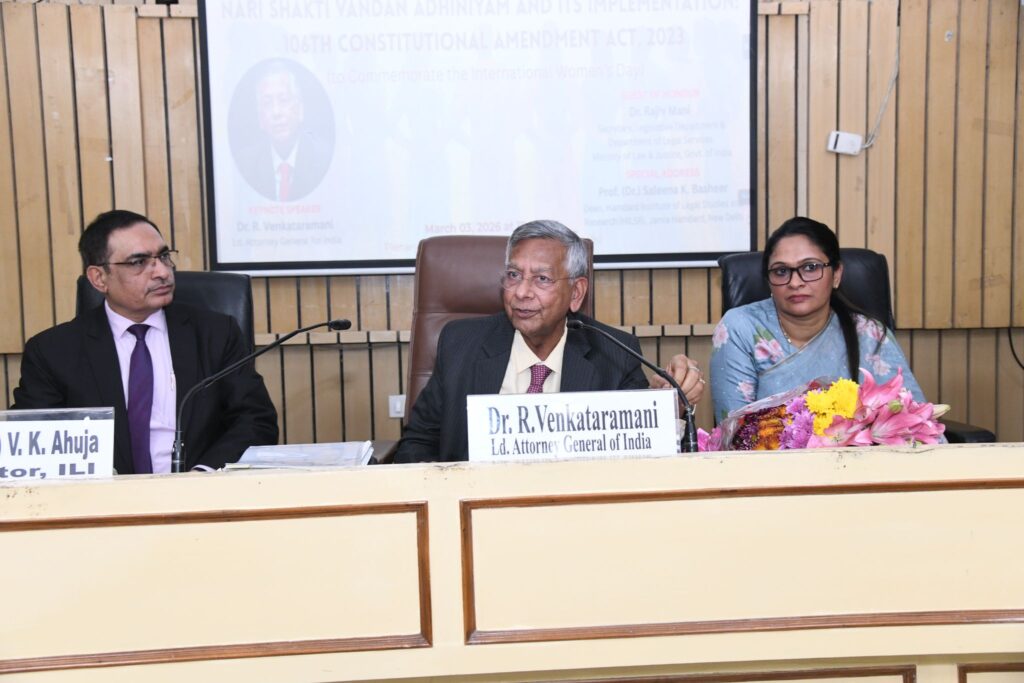
To deliberate on this shift, the Indian Law Institute (ILI), in collaboration with the Commonwealth Legal Education Association (CLEA), recently convened a National Symposium. The insights shared by the nation’s top legal minds, including the Attorney General for India, provide a blueprint for how India is reimagining gender justice through the lens of the Constitution.
The Power of Symbolic Nomenclature:
A recurring theme of the discourse was the weight of words. As Prof. (Dr.) Saleena K. Basheer (Dean, Hamdard Institute of Legal Studies) observed, the title “Nari Shakti Vandan Adhiniyam” is a departure from the clinical “Mahila Arakshan” (Women’s Reservation).
While “reservation” often implies a concession, “Vandan” (Adoration/Salutation) signals a civilizational recognition of women’s inherent power. This isn’t just semantics; it is a communication of constitutional intent. With women now steering the highest offices from the Presidency to the Union Finance Ministry. The Act codifies a spirit of leadership that is already reshaping the Indian identity.
Bridging the Gap: The Attorney General’s Perspective:
In a powerful keynote address, Attorney General for India, R. Venkataramani, highlighted that there is a requirement to bridge the gap between historical ideals and modern legal necessity. Reflecting on the foundational values of the Constitution, he noted:
“Rhetoric is important because it evokes emotion and propels reflection.”
The Attorney General challenged the legal community to view the 106th Amendment not as a static document, but as a “continuing process” shaped by legislative will and societal readiness. He drew a poignant parallel to the abolition of untouchability, questioning why gender divides. Often the most persistent of social barriers have taken this long to be addressed at a structural level.
Understanding the 106th Amendment: A Structural Overview:
To appreciate the magnitude of this reform, one must look at the specific constitutional machinery it introduces. The Nari Shakti Vandan Adhiniyam inserts Articles 330A, 332A, and 334A into the Constitution, creating a framework that is both ambitious and time-bound:
The 33% Mandate: The Act reserves one-third of all seats for women in the Lok Sabha, State Legislative Assemblies, and the Legislative Assembly of the National Capital Territory of Delhi.
Intersectionality: Crucially, the reservation extends to the seats already reserved for Scheduled Castes and Scheduled Tribes, ensuring that representation is inclusive across social strata.
The Sunset Clause: In a move toward “calibrated execution,” the reservation is initially slated for a period of 15 years, allowing Parliament the flexibility to review and extend the mandate based on the evolving political landscape.
Rotational Representation: Reserved seats will be rotated after every delimitation exercise, preventing the stagnation of political power and encouraging women’s leadership across all constituencies.
Navigating the Path to Implementation:
A critical point of the symposium addressed the “how” and “when” of the Act’s operationalization. The Attorney General provided much-needed clarity on the Delimitation Linkage. Under the Act, the reservation will come into effect after the first census published post-2023 is used for a fresh delimitation exercise.
He suggested that these phases should be viewed through the lens of “calibrated execution” rather than legislative reluctance. For a reform to be durable, it must be built on a foundation of procedural and constitutional necessity, ensuring that the structural compliance of the federal setup is absolute.
Conclusion: Suniti Legal’s Vision for an Inclusive Future:
The consensus from the Indian Law Institute was clear: the implementation of the Nari Shakti Vandan Adhiniyam is not merely a procedural exercise. As Senior Professor (Dr.) V.K. Ahuja, Director of ILI, emphasized, it is a vital part of the larger constitutional goal of social transformation through law.
At Suniti Legal, a firm proudly headed by women, we recognize that the law is only the starting line. Our mission is to bridge the gap between “legislative intent” and “lived reality.” We are committed to creating a space that breathes life into the spirit of Nari Shakti empowering representation in every sense, from the courtroom to the boardroom.
By fostering inclusive spaces and providing robust legal advocacy, Suniti Legal stands at the forefront of this constitutional journey. We believe that true gender justice is achieved when every woman sees herself reflected in the institutions that govern her. As we celebrate International Women’s Day, we reaffirm our dedication to a future where representation is not a quota, but a cornerstone of our democracy.